
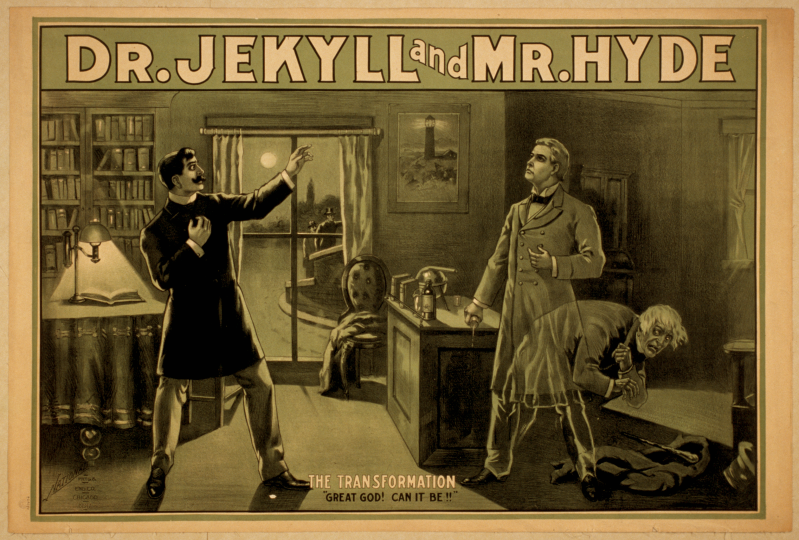
I am teaching The Strange Case of Dr. Jekyll and Mr. Hyde this week. My students all know Dr. Jekyll and Mr. Hyde. Or rather, they know the main conceit: that Hyde is Jekyll. Most of my students have never read Stevenson’s original story, but it has become like a minor Frankenstein, absorbed into the fabric of popular culture.
What this obscures is something really quite interesting about the story–that is it is centrally a mystery. The primary conflict or problem that motivates the plot revolves around the question of the relationship between the odious Mr. Hyde and the upstanding Dr. Jekyll. In its original context, for readers who do not come to the text with the knowledge that the two figures are one in the same, the entire interest of the text is bound up in that discovery.
I try to stress this to my students, and we approach the issue in a couple of different ways. As artificial as mapping out plot using structures like Freytag’s pyramid can be, in this case it is sometimes helpful. Reducing the story to its elements of plot lets us look at it as a structure, and focus not on what we already know about the Jekyll and Hyde relationship, but on how and when that information is presented. I also ask them to put themselves in the shoes of a late-Victorian reader who comes to the text with no foreknowledge. I ask them to think about their experiences with similar narratives from their own media context. Fight Club is always useful (and can be viewed as an adaptation of Jekyll and Hyde). Most of my students have seen the film, some have even read the novel, so I ask them to think about when they first saw it and what the experience of the “twist” was like. I suspect that Fight Club will soon be too far in the past for most of my students, so I’m looking for more recent examples that help them view Stevenson’s novella from a fresher point of view.
I also wonder how long the mystery at the heart of Jekyll and Hyde lasted in its own time. It couldn’t have been too long. Punch published their parody “The Strange Case of Dr. T and Mr. H” within a month of the original novella, and (as seen above) numerous materials from the period advertising stage adaptations depict the Jekyll/Hyde split. Still, I never cease to wonder what it was like to follow the labyrinth of documents that make up Stevenson’s narrative to the revelation at the novel’s heart. Coming to the text with the knowledge I have, I can’t help but feel a little bit cheated.


 "Quickly, to the Panopticon!"