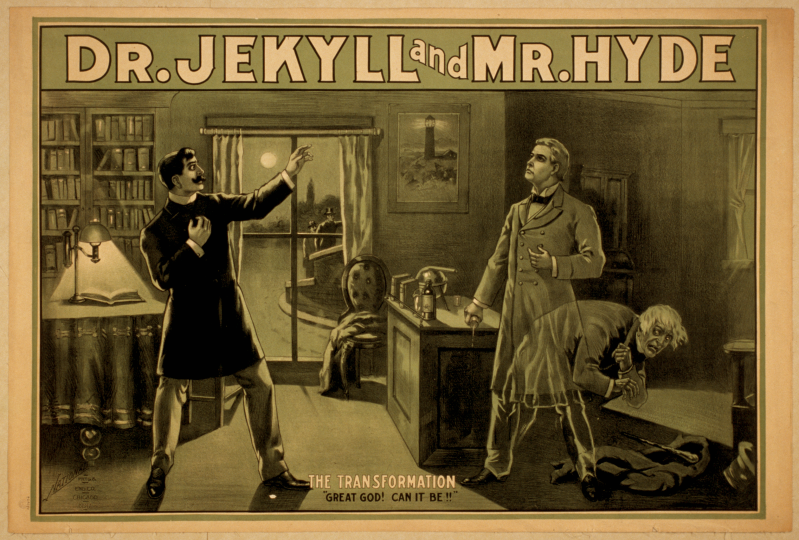
Jekyll, Hyde, and the secret everyone knows

I am teaching The Strange Case of Dr. Jekyll and Mr. Hyde this week. My students all know Dr. Jekyll and Mr. Hyde. Or rather, they know the main conceit: that Hyde is Jekyll. Most of my students have never read Stevenson’s original story, but it has become like a minor Frankenstein, absorbed into the fabric of popular culture.

What this obscures is something really quite interesting about the story–that is it is centrally a mystery. The primary conflict or problem that motivates the plot revolves around the question of the relationship between the odious Mr. Hyde and the upstanding Dr. Jekyll. In its original context, for readers who do not come to the text with the knowledge that the two figures are one in the same, the entire interest of the text is bound up in that discovery.

I try to stress this to my students, and we approach the issue in a couple of different ways. As artificial as mapping out plot using structures like Freytag’s pyramid can be, in this case it is sometimes helpful. Reducing the story to its elements of plot lets us look at it as a structure, and focus not on what we already know about the Jekyll and Hyde relationship, but on how and when that information is presented. I also ask them to put themselves in the shoes of a late-Victorian reader who comes to the text with no foreknowledge. I ask them to think about their experiences with similar narratives from their own media context. Fight Club is always useful (and can be viewed as an adaptation of Jekyll and Hyde). Most of my students have seen the film, some have even read the novel, so I ask them to think about when they first saw it and what the experience of the “twist” was like. I suspect that Fight Club will soon be too far in the past for most of my students, so I’m looking for more recent examples that help them view Stevenson’s novella from a fresher point of view.

I also wonder how long the mystery at the heart of Jekyll and Hyde lasted in its own time. It couldn’t have been too long. Punch published their parody “The Strange Case of Dr. T and Mr. H” within a month of the original novella, and (as seen above) numerous materials from the period advertising stage adaptations depict the Jekyll/Hyde split. Still, I never cease to wonder what it was like to follow the labyrinth of documents that make up Stevenson’s narrative to the revelation at the novel’s heart. Coming to the text with the knowledge I have, I can’t help but feel a little bit cheated.

Posted in Victorianism | Tagged , , | Leave a comment

Werner Herzog coming to USF, November 19th

Acclaimed director Werner Herzog will be here at the University of South Florida next month. Here’s the announcement:

An Afternoon with Werner Herzog
Nov. 19, 3pm
ISA 1051

The world-renowned German director Werner Herzog will show a new film project and discuss his work with
USF students, faculty, staff, and Tampa Bay cineastes.

Werner Herzog made his first film in 1961. Since then he has produced, written, and directed more than fifty
feature and documentary films and directed a dozen operas. He has been nominated and won numerous
international awards for his films, including an Academy Award, a Golden Globe, a BAFTA Award, four Cannes
Palm d’Or Awards, two Independent Spirit Awards, a Sundance Film Festival Award, four Venice Film Festival Awards,
an Emmy, and two Berlin International Film Festival Awards.

He became a celebrated director in the US as a member of the film movement New German Cinema in the 1970s
and 80s with his films Aguirre, Wrath of God, Nosferatu the Vampyre, and Fitzcarraldo. His recent films include
Grizzly Man, The Bad Lieutenant: Port of Call-New Orleans, Encounters at the End of the World, Rescue Dawn,
and Cave of Forgotten Dreams.

His latest film Into the Abyss, a documentary about two death row inmates in Texas, was screened recently
at the Telluride and Toronto International Film Festivals and will soon receive a wide release in the US.

For more information, please contact Margit Grieb (grieber@usf.edu)

This event is sponsored by the German Embassy, the Humanities Institute,
the College of Arts & Sciences, the Departments of Communication,
English, History, Humanities & Cultural Studies, Philosophy, and World Languages.

Posted in Uncategorized | Tagged | Leave a comment

Starting with poetry, or, why I teach “Dover Beach” on the first day

Elaine Showalter’s Teaching Literature begins with a focus on teaching and anxiety, moves through theories and methodologies, and then in chapter four gets down to the nitty-gritty of teaching by genre. She begins this section with a focus on poetry and I appreciate her arrangement. She notes that poetry tends to garner a fair bit of student resistance (indeed, I would argue that poetry in some ways becomes the horrid face of literature to a number of resistant students), and that, quoting Ann Lake Prescott, “even good students can arrive at college afraid of it” (62). If poetry is, as I think, emblematic for many students of all they expect to loath about a literature class, then perhaps it is important to put it out on the table, poke it a bit, and show them that it is not so awful after all. If nothing else, the short story might just seem a little easier afterwards.

I have taught Intro to Lit classes in a couple of different versions and formats. While I may not always have poetry as the first unit when I divide by genre, I have always addressed poetry in the first class. After doing some introductory getting to know you stuff, and going over the syllabus, and a very brief intro to what we’ll be doing in the classroom, I bring out “Dover Beach.” I’m a Victorianist generally so it’s my milieu. I bring copies for students who don’t have their anthologies yet, and I read the poem aloud to the students. Afterwards we go back through the poem line by line and explicate it together as an introduction to close reading.

I do this for several reasons. The first is, as I mentioned above, to put poetry on the table. There are also practical considerations too. I want my students to get some idea of the content of the course on the first day, and reading a poem out loud to them is more manageable than setting them all to read and respond to a short story during the remaining class time. I also do it, in some respects, for entertainment value. I know “Dover Beach” really well, I can give them the context, and more importantly I can poke fun at Arnold’s seriousness (this is his honeymoon after all!) and invite them to do the same. I can ask them, “how would you feel if your girlfriend, or boyfriend, or husband, or wife, said ‘honey, the world is a terrible horrible place, everything is awful, it’s really bad, there’s nothing good about it, except you. You’re it. So you’d better love me,’? Would you consider it romantic?”

At the same time it allows me to prompt them for critical thought, I can ask them specific questions that allow for the first steps of interpretation: “What does it mean to describe faith as a sea, and then express that the sea has gone out with the tide?” I’ve had very good experiences prompting students with these kinds of questions. I use “Dover Beach” because I have command over it, but also because it is just the right kind of alien for them. It is close enough to contemporary language for minimal gloss, yet far enough in time and context for them to feel that when they grasp it, they are grasping something other.

Reciting poetry to students is something that Showalter represents as an often times useful “teacher centered approach”. I agree. In general I don’t want to be the center of the discussion. I want to facilitate, and I don’t want to subscribe to such a “teacher centered” pedagogy on the whole. However, I think taking a little bit of time and effort to hold court on a poem the first day of class is an appropriate use of such an approach. It helps to introduce not only the literature, but you as an individual to the students. In the same way a successful introduction of poetry can set the tone for an engagement with the literature generally, a successful introduction as an instructor can set the tone for the rest of the class.

Posted in Pedagogy | Tagged , , | Leave a comment

Informative Coincidences

The class I currently teach is an Introduction to Literature course focused on adaptations and retellings. I created most of the syllabus for the class in the Fall of 2009 for the Practice Teaching Literature graduate course at USF. When I put it together I selected Joyce Carol Oates’s story ”Where Are You Going, Where Have You Been?, Don Moser’s “The Pied Piper of Tucson,” and the lyrics from Bob Dylan’s “Its All Over Now Baby Blue.” Moser’s piece is an article that appeared in Life Magazine in 1966, and it is the basis for the Oates story. “The Pied Piper of Tucson” is about Charles Schmid who murdered at least three teenagers in Arizona between 1964 and 1965. The case, because of the reporting of Moser and others like him became a national topic.

As I said I selected these readings in the Fall of 2009. I first taught this course last Spring, and about two weeks before I was scheduled to teach this cluster of stories Jared Lee Loughner opened fire on a political event in Tucson killing six people including a federal Judge and a 9 year old girl and injuring eleven others, including U.S. Congresswoman Gabrielle Giffords.

I was re-reading and annotating Moser’s article the weekend following this event in preparation for teaching it, and I was struck by an interesting passage at the end. After chronicling the events and the bizarre figure of Charles Schmid Moser notes: “The people of Tucson wait uneasily for what fresh scandal the two trials may develop. Civic leaders publicly cry that a slur has been cast o their community by an isolated crime.”

I was struck by this, of course because I–like most people who followed the shooting spree in Tucson–heard a number of local officials saying the exact same things. I saw the mayor himself attempt to dodge around the statements that the sheriff made, and insist on the health and happiness of the community. But, just like in 1966, there’s something wrong. These claims of isolation are perhaps true on the level of the individual crime, but it’s hard to deny that something is amiss. Don Moser’s article focused on Charles Schmid, but it also used Schmid as a way of thinking and talking about the dark things that were going on in America. It shouldn’t be surprising that Hitchcock’s Psycho which also examined the dark undercurrent in our national life opened just a few years before in 1960 and took as its territory that American no man’s land between Arizona and California, (starting in Phoenix and ending in a fictional Northern California town).

The correlation between my planned teaching of this article and the more recent events in Tucson was a coincidence, but an informative one. Moser recognized something going wrong in America and used the story of a young and apparently popular serial killer to illuminate it. I brought this up in class and my students responded pretty well, recognizing that the Tucson shooting perhaps should be viewed as a way for us to step back and search for precisely what ails us as a nation and as a culture, political or otherwise. While the conversations regarding civility, the damage of overheated rhetoric, and the problems of demonizing one’s political opponents have taken a back seat to more basic concerns (echoed in the Occupy Movements spreading across the country) my students responses give me a tiny bit of hope that we can perhaps in the near future move a little further away from the current paradigm.

Posted in Uncategorized | Leave a comment

All Hallow’s Read

Last year writer Neil Gaiman made a modest proposal which has led to a burgeoning new tradition called All Hallow’s Read. All Hallow’s Read aims to promote reading amongst all ages, and is a great way to celebrate the season. I think I’ll be combing some used bookstores for Shirley Jackson to give out over the next few weeks.

Posted in Uncategorized | Leave a comment

Apropos, as the nights are getting longer

In my meager free time, I’ve been re-reading At Day’s Close: Night in Times Past by A. Roger Ekirch. It is an excellent cultural history of the nocturnal sphere, focusing primary from the early modern period into the 18th century. There are amazing tidbits scattered throughout, and even re-reading it I hardly go a page without being surprised.

Coincidentally, I came across this review in the Times Literary Supplement of Evening’s Empire: A History of the Night in Early Modern Europe by Craig Koslovsky, a new scholarly work that tackles similar territory. The reviewer unfortunately misses the significance of Ekirch’s work, but a quick use of Amazon’s “Search Inside” function shows that Koslofsky does not. It looks like it might be a fitting companion to Ekirch’s text.

Posted in Uncategorized | Tagged | 2 Comments

First Post

This blog is intended as place where I can discuss my academic interests in a more informal way. Here you will find discussions of what I’m reading, what I’m teaching, and what I’m researching.

Posted in Uncategorized | Leave a comment